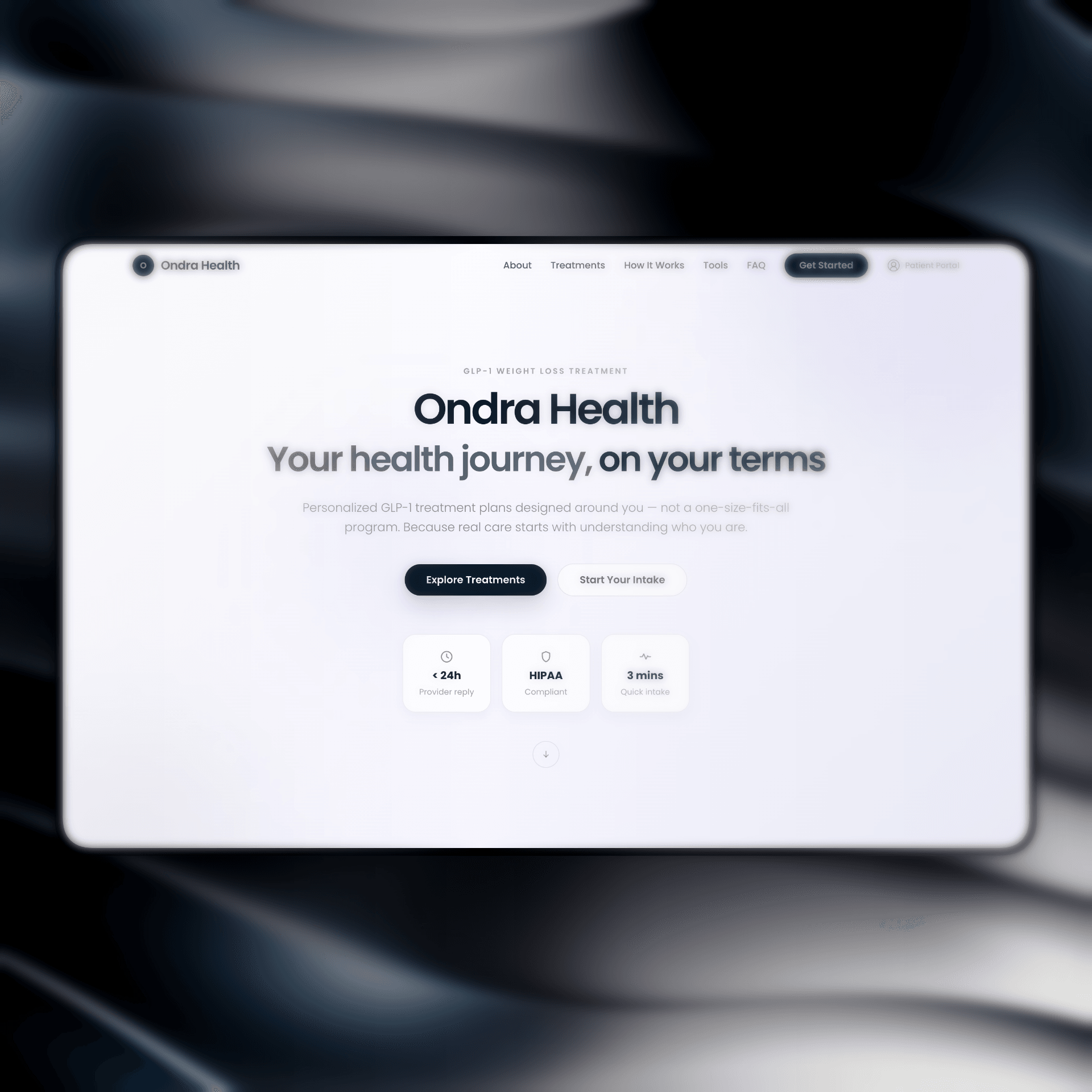
Websites for GLP-1 and weight management clinics
The most scrutinised marketing surface in healthcare right now, and the one where a template causes the most trouble.
Best for telehealth and in-clinic weight management programmes, and for med spas adding a medically supervised GLP-1 service.
Weight management clinics are being built faster than almost any other healthcare category, and most of them launch on a template built for a med spa. That is a problem, because this vertical carries constraints a facial does not: a prescribing relationship, state-by-state licensure, a questionnaire full of clinical information, and a regulatory environment paying close attention to what gets claimed.
Say where you can actually treat, on the first screen
Telehealth prescribing is licensed state by state, so a clinic licensed in four states receives enquiries from fifty. Every enquiry from outside your footprint costs staff time to decline and costs the person a wasted expectation. Putting the states you serve high on the page feels like turning business away and does the opposite: it filters the enquiries you could never have accepted and it signals that you understand the rules, which in this category is itself a differentiator.
The eligibility form is a clinical intake wearing a marketing costume
The questionnaire that qualifies someone for a programme asks for weight, height, medical conditions, current medications and sometimes prior treatment. Attached to a name and an email, that is health information about an identifiable person, and it should not be collected by a standard website form dropping into a standard inbox. This is the single most common structural mistake in the vertical, because the form is also the conversion path and it gets designed by whoever is optimising conversion. Split it: the marketing site qualifies interest, and the clinical screening happens in a system built to hold it.
You are competing against a trust deficit you did not create
The category has attracted operators making claims that will not survive scrutiny, and prospective patients have learned to be sceptical. That is an opportunity for a legitimate clinic, because the differentiators are cheap and most competitors skip them: named prescribing clinicians with credentials, a stated medical director, what happens at each stage of a programme, how monitoring works, what the medication actually is, and what the total cost includes. A site that answers those reads as a medical practice. A site that leads with a transformation photograph reads as everything the sceptic is worried about.
What the site should not say
Specific outcome promises, guaranteed results, and imagery presented as typical are all territory where advertising rules are enforced and where a clinic's own regulator may take a view. This is not a design opinion. It is that the strongest copy in this vertical describes the programme, the supervision and the process honestly, and lets the reader draw the conclusion, and that this happens to be both the safer and the more persuasive option for the sceptical buyer you are trying to reach.
- The states you are licensed to treat in, stated where nobody can miss them
- Eligibility screening routed into a system built for clinical information
- Named clinicians and a named medical director, with real credentials
- The programme described stage by stage, including monitoring and follow-up
- Total cost and what it includes, because the alternative is an enquiry that ends in surprise
A site that leads with a transformation photograph reads as exactly what the sceptical buyer is already worried about.
One note on how this page is written. It describes what a website in this category has to do and where the obvious traps are. It is not legal, regulatory or clinical advice, and what any given clinic may say or collect depends on its licensure, its jurisdiction and its own counsel. What a web team can offer is a build whose boundaries are explicit, so those decisions get made with the facts visible.
What a build here actually includes
Every build is scoped to the practice, but on this kind of site these are the parts that are not optional.
- Licensed states surfaced prominently rather than buried in terms
- Eligibility screening separated from the marketing form and routed appropriately
- Clinician and medical director profiles with verifiable credentials
- Programme, monitoring and follow-up explained stage by stage
- Pricing structured so the total and its inclusions are clear before an enquiry
What we keep seeing go wrong
None of these are hypothetical. They are the things that turn up again and again on sites in this vertical, and most of them are cheap to avoid and expensive to undo.
- A med spa template carrying a prescribing service it was never designed for
- Collecting weight, conditions and medications through a standard website form
- No statement of which states the clinic is actually licensed to treat in
- Before and after imagery doing the persuading instead of the programme description
- A price that turns out to exclude the medication, the labs or the follow-up
Questions we get asked first
- Can we use before and after photographs?
- That is a question for your counsel and your regulator rather than for us, and the answer varies by jurisdiction and by how the imagery is presented. What we will say is that in this category they tend to persuade the wrong buyer. The sceptical, higher-intent patient is looking for evidence of medical supervision, and transformation photography reads to them as the marketing they have learned to distrust.
- Where should the eligibility questionnaire live?
- Not in a standard website form emailing a standard inbox. Once weight, conditions or medications are attached to a name, it is health information and it needs handling under agreements a website form does not provide. The pattern that works is a short marketing form that books a conversation or hands off to a screening system built to hold clinical information.
- How do we look legitimate in a crowded category?
- By publishing what the operators cutting corners will not. Named clinicians with checkable credentials, a named medical director, the programme described stage by stage, how monitoring works, and what the price actually includes. These are unglamorous and they are precisely the things a sceptical patient is scanning for.
- Do we need separate pages for telehealth and in-clinic?
- If you offer both, yes. They are different experiences with different eligibility, different pricing and often different licensure. Merging them produces a page that describes neither accurately and generates enquiries from people who wanted the other one.