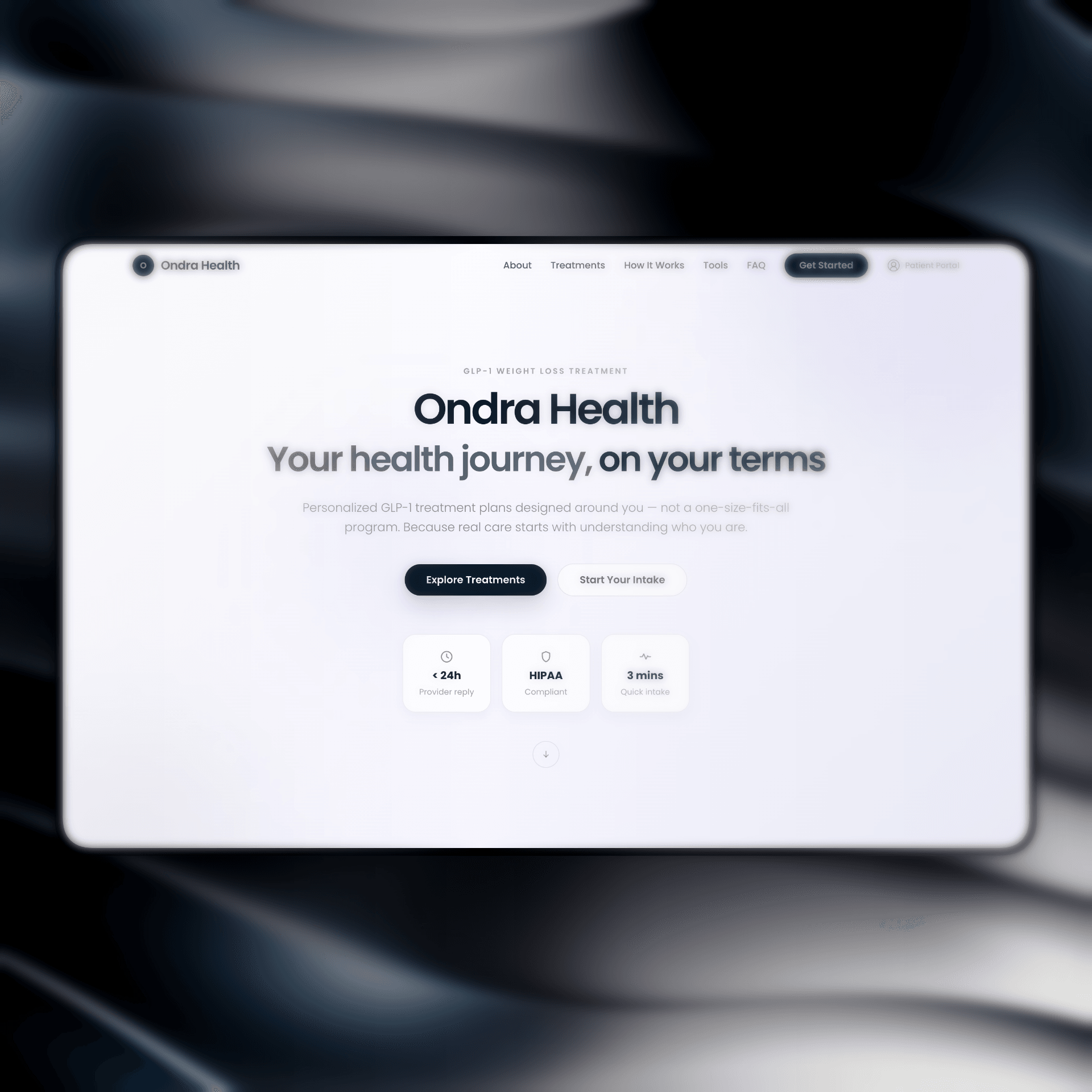
Websites for ABA therapy practices
A site that reassures a parent, answers the insurance question early, and helps you hire, without collecting anything it should not.
Best for ABA and autism therapy clinics, and multi-site providers, whose website has to do intake, insurance and recruiting at the same time.
We have worked on more than 40 ABA websites. Applied behavior analysis is the therapy most autism diagnoses lead to, so these clinics are usually the second call a family makes after a paediatrician, and that shapes everything. It is enough of them to notice that ABA practices tend to get the same things wrong, and that almost none of it is about how the site looks. It is about what the site is asked to do, which is three separate jobs at once: convince a parent, satisfy a payer, and recruit the clinicians you cannot operate without.
The insurance question decides the enquiry
The first thing a parent wants to know is whether you take their plan. The second is how long the wait is. Neither is a nice-to-have detail: they are the two facts that determine whether an enquiry is worth sending at all, and most ABA sites bury both behind a contact form.
Putting payer information, the verification steps and an honest line about the waitlist above the form costs you the enquiries that were never going to convert, and it wins the ones that were. Practices resist this because it feels like turning people away. In practice it filters, and a filtered enquiry is a shorter call.
Intake is a build decision, not a disclaimer
The moment a form asks about a diagnosis it is touching protected health information, and a standard form handler is not somewhere that may hold it. This gets treated as a legal question when it is really an architecture question: what the form collects, where the submission is stored, who it is emailed to, and which questions belong on a call instead.
Those decisions have to be made before the form is styled, because they change which vendor you can use and sometimes which fields can exist at all. A note at the bottom of the page does not change what a system is doing with the data.
Recruiting is the second funnel, and often the better one
ABA practices hire continuously, and BCBA and RBT candidates research an employer with exactly the scrutiny a parent applies to a provider. They want to know supervision ratios, caseload, what the training pathway looks like, and whether the people already there seem happy.
A careers section built as a real part of the site rather than a link out to a job board is frequently the highest-return work on an ABA build, because a filled BCBA post is worth more than a marginal enquiry and the competition for that attention is far weaker.
Every location has to be findable on its own
Multi-site clinics need each location to rank in its own town, and that is a local SEO job rather than a template job. The tempting move is one page per site with the town name swapped in, which is the pattern search engines have recognised for years and the reason a lot of clinic sites have location pages that have never ranked for anything.
- A business profile per location, treated as a live asset rather than claimed once and forgotten
- A page per clinic that says something true about that clinic: the team there, the rooms, the catchment, the wait
- Schema tying each location back to the practice, so the relationship is machine-readable
- Reviews answered, all of them, because the reply is a ranking and a conversion signal at once
A parent choosing a clinic and a BCBA choosing an employer are both deciding whether to trust you, from the same pages, on the same afternoon.
What a build here actually includes
Every build is scoped to the practice, but on this kind of site these are the parts that are not optional.
- An intake flow specified before it is styled: fields, storage and routing decided against what the form may hold
- Payer and waitlist information placed above the enquiry, not below it
- A careers section built as part of the site, with supervision, caseload and training pathway answered
- A page and a business profile per clinic, each saying something true about that location
- A CMS your team can run without a developer, so the waitlist line is never out of date
What we keep seeing go wrong
None of these are hypothetical. They are the things that turn up again and again on sites in this vertical, and most of them are cheap to avoid and expensive to undo.
- Insurance answered somewhere below the contact form, or not at all
- One location page per town, built from a template with the name swapped
- A careers page that is a link out to a job board
- An intake form on a handler that was never meant to hold health information
- Stock photography of children that belongs to no clinic and reassures nobody
Questions we get asked first
- Do you build the site so it is HIPAA compliant?
- A website is not itself HIPAA compliant. The agreements, the hosting and the handling around it are, and a good part of that belongs to your practice rather than to us. What we do is build so the site is not the weak point: the intake is specified against what it may collect, the submission goes somewhere appropriate, and anything that should be on a call is on a call. We will tell you plainly which parts remain yours.
- Can you work with our existing intake or EHR system?
- Usually. The question is what the system exposes and what your agreement with that vendor allows, which is worth checking before the build rather than during it. Where a direct connection is not sensible, the site hands off cleanly to the system instead of trying to duplicate it.
- We have five clinics. Do we need five websites?
- No, one site with a real page per location. Separate sites split your authority five ways and multiply the maintenance. A single site with location pages that each say something true about that clinic, tied to a business profile per location, is both cheaper and stronger.
- How long does a build take?
- Most run four to eight weeks from kickoff. The variable is rarely design; it is how quickly decisions come back on intake and on what each location may claim. Those questions land in week one for that reason.